Best AI Chatbot Comparison Tool in 2026 (Compare 5 Models at Once)
8/5/2026 · Chativo Editorial · 8 min read
An AI chatbot comparison tool shows several model answers to the same prompt at once, so you can pick a winner instead of guessing. Tabs, extensions, and five separate subscriptions all do a weaker version of this. A dedicated workspace streams ChatGPT, Claude, Perplexity, Gemini, and Grok together, then lets you continue with the model you trust.
| Approach | Same prompt? | Live parallel answers | Continue with a winner | History in one place | What it costs you |
|---|---|---|---|---|---|
| Five official tabs | Only if you never edit | No | In five products | Split | Time plus several bills |
| Browser extension | Usually | Sometimes | Often awkward | Tied to the browser | Setup and limits |
| Five subscriptions | Rarely | No | Yes, separately | Five inboxes | Highest cash cost |
| Dedicated comparison workspace | Yes, by design | Yes | Yes | Yes, after you register | One plan |
If your job is “get a usable answer,” any chatbot works. If your job is “do not ship the first plausible paragraph,” you need a comparison layer. That is the category.
The five-model flagship write-up is ChatGPT vs Claude vs Gemini vs Grok vs Perplexity. This page is about the tool, not a ranking of personalities.
What an AI chatbot comparison tool actually does
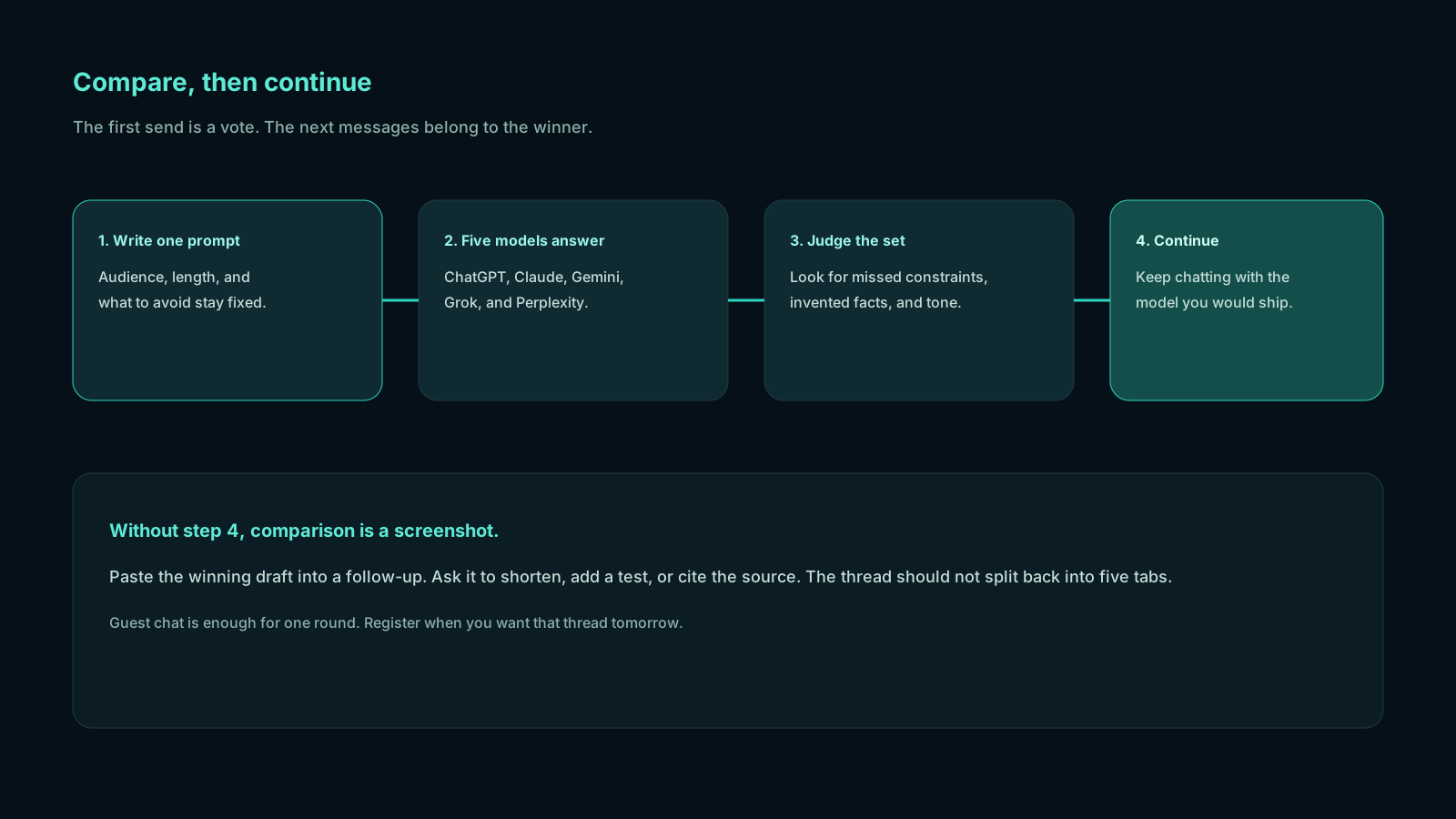
An AI chatbot comparison tool is not a leaderboard. It is a workspace that keeps the input identical and the outputs adjacent.
The useful sequence is narrow:
- You write one prompt.
- Several models answer it at the same time.
- You judge the answers against the same checklist.
- You keep talking to the model that earned the next turn.
Without step 4, comparison is a screenshot. You still have to paste the winning draft into another product to finish the work. A real tool treats “pick a winner” as the start of the thread, not the end of the demo.
That is also how this differs from a multi-model AI chat platform that only offers a model dropdown. A dropdown still hides four answers. You cannot compare what you never saw.
What it is not
It is not an API router for developers who want to swap keys. It is not a “best of” mash-up that secretly blends five replies into one mystery paragraph. Blending sounds clever until you cannot tell which model invented the price.
It is not a substitute for your own judgment. If four models agree on a bad brief, you still wrote a bad brief.
Compare AI chatbots without five subscriptions

The expensive way to compare AI chatbots is to pay each vendor, then forget which chat lived where.
ChatGPT Plus is typically around $20 a month for one model family. Claude, Gemini, Grok, and Perplexity each have their own paid tiers. Exact 2026 prices change, and they are not the point. The point is you are funding five homes for one habit: “I wonder if the other one would have been better.”
That habit is rational. Models miss different things. What is not rational is rebuilding the prompt five times.
A comparison tool collapses the habit into one send. You still might keep a favorite vendor account for a specialized workflow. You should not need five accounts to decide whether today’s email should sound like Claude or ChatGPT.
Cash is only one cost. The other is context. Your best examples, your banned phrases, your “this client hates exclamation marks” notes scatter across products. Then you blame the model for a miss you caused by starving it of the thread.
Why a browser extension is a compromise

Extensions exist because people already live in Chrome. That is a real advantage: you highlight text on a page and ask for a rewrite.
They are still a compromise for serious comparison.
- The workspace is a panel, not a place you return to.
- History is easy to lose when you switch machines or clear the profile.
- Streaming five answers in a sidebar gets cramped. You skim instead of judging.
- Login, cookies, and site-by-site quirks become part of the test.
If your whole job is “rewrite this paragraph on this page,” an extension can be enough. If your job is shipping copy, code, or research you will reuse tomorrow, you want a dedicated page with a real thread.
Compare AI models side by side is the how-to. This article is the buying question: what kind of product should that how-to run on?
What to look for in an AI model comparison tool
Skip feature lists that sound like every other AI homepage. Check for these behaviors.
One prompt, many streams. If you have to click send five times, it is a launcher, not a comparison tool.
The models you actually mean. For this product, that is ChatGPT, Claude, Perplexity, Gemini, and Grok. A giant catalog is less useful than the five you would have opened anyway.
Continue with the chosen model. After the first round, you should not start over in another app.
Guest try, then history. You should be able to test the idea without a lecture. You should also be able to keep the thread if the test worked. Guest chat exists here; register to keep history.
Pricing you can explain. Starter at $5/month, Plus at $10/month, and Pro at $20/month is a different conversation from five overlapping subscriptions. Pakistan-friendly checkout via Safepay matters if international cards are a weekly problem.
No fake scores. A tool that slaps 9.4 on Claude and 8.1 on Gemini is inventing a sport. You need the text.
If a product fails the first two checks, it will not change how you work. It will become another tab.
How to run the same prompt in a comparison workspace
Use a prompt that already has consequences. A toy question produces a toy comparison.
- Go to chat. You can start as a guest.
- Paste the real task: the email, the failing stack trace, the research question, the outline you distrust.
- Add constraints in the same message: length, audience, format, things to avoid.
- Send once. ChatGPT, Claude, Perplexity, Gemini, and Grok stream in parallel.
- Score the five replies with a short list: followed instructions, invented facts, usable structure, tone you would sign.
- Continue with the winner. Ask for the revision, the tests, or the citations in that same thread.
- Register if you want the comparison saved.
Compare these models on Chativo with one prompt from today, not a prompt designed to flatter a model. If you will do this more than once a week, See packages.
A scoring list you can reuse
Keep it ugly and short. Four checks are enough:
- Instruction follow. Did it keep the word limit and the format?
- Hallucination risk. Did it add a number, quote, or API that you cannot see in the prompt?
- Structure. Can you use this without rebuilding the skeleton?
- Tone. Would you paste this into Slack, a PR, or a client thread?
The AI chatbot comparison tool’s job is to put five answers under those four checks at the same time. Your job is to be honest about the checks.
Who actually needs this
Writers and marketers. You already know one model will oversell and another will under-sell. Seeing both drafts in one pass is faster than arguing with a single chatbot.
Developers. A fast wrong patch wastes more time than a slow right one. Comparing a Grok one-liner with a Claude review on the same error is a cheap insurance policy.
Students. Agreement across models is not proof, but disagreement is a study clue. If four answers conflict, you do not have an answer yet.
Freelancers. You cannot bill a client for “I had a feeling ChatGPT was off today.” You can bill for a deliverable you checked against another model.
Anyone paying for two or more AI subscriptions out of fear. Fear is a pricing plan. Comparison is a cheaper habit.
You do not need an AI chatbot comparison tool if you only want small talk or a single coding snippet you will immediately run. You need one when the cost of a wrong-confident answer is higher than the cost of reading a second draft.
What changes after the first week
The first session feels like a novelty: five answers, pick a favorite.
The second week is quieter. You stop having a “main” model in the abstract. You have a main model for this prompt. That is the whole point of the category.
You also write better prompts, because a constraint you forgot shows up five times. If every model ignores your word count, the word count was buried. If only one model invents a source, you just watched a hallucination happen instead of reading it in a finished doc.
That feedback loop is why a dedicated AI model comparison tool beats a graveyard of chats titled “New conversation.”
Frequently asked questions
Straight answers to the questions this article usually raises. Each question is separate from its answer so you can scan on a phone or a desktop.
What is an AI chatbot comparison tool?
An AI chatbot comparison tool sends one prompt to several models and shows the answers together. In this workspace that means ChatGPT, Claude, Perplexity, Gemini, and Grok streaming in parallel, then a follow-up with the model you choose.
Is a comparison tool the same as having five AI subscriptions?
No. Five subscriptions give you five products. A comparison tool gives you one test. You can still keep a vendor account you love. You should not need all five accounts just to decide which draft to keep.
Can I compare AI chatbots without installing an extension?
Yes. A dedicated page is enough. Open the chat, send the prompt, read the five streams. You do not have to pin a browser panel to make the comparison valid.
Do I have to register before I try it?
No. Guest chat exists so you can run a prompt first. Register when you want history kept.
How much does a dedicated comparison workspace cost?
Plans here are Starter at $5/month, Plus at $10/month, and Pro at $20/month, with Safepay checkout that is usable from Pakistan. See packages for details rather than stacking five separate AI bills.
Related reading
- ChatGPT, Claude, Gemini, Grok, and Perplexity in One App
Run one prompt across ChatGPT, Claude, Gemini, Grok, and Perplexity in a single chat, then continue with the answer you actually want to use.
- Best Side-by-Side AI Comparison App for Daily Work
A side by side AI comparison app should stream several model replies on one prompt, then let you continue with the winner. Here is what daily work actually needs: parallel chat, projects, and guest mode.
- What Is a Multi-LLM Chat Platform and Why Teams Are Switching
A multi-LLM chat platform runs several language models in one workspace so you can compare answers and continue with the one you trust. Here is what the category is, and why people use it.