ChatGPT vs Claude vs Gemini vs Grok vs Perplexity: Which AI Wins in 2026?
8/3/2026 · Chativo Editorial · 10 min read
There is no single winner in ChatGPT vs Claude vs Gemini in 2026. ChatGPT is the flexible all-rounder, Claude often produces cleaner long-form writing, Gemini is useful when you want Google-shaped answers, Grok is faster and more blunt, and Perplexity is strongest when you need sources. Run one prompt on all five before you pick.
| Task | ChatGPT | Claude | Gemini | Grok | Perplexity |
|---|---|---|---|---|---|
| Everyday writing | Strong, adaptable | Often the cleanest draft | Solid, sometimes generic | Short and punchy | Fine, not the point |
| Coding help | Broad and practical | Careful with edge cases | Good on common stacks | Fast first pass | Weak unless the question is documented online |
| Research | Useful synthesis | Strong reasoning, weaker live web | Good on familiar topics | Direct, mixed sourcing | Best first look at the open web |
| Speed of useful output | Fast enough | Can be slower on long answers | Usually quick | Often the snappiest | Fast when the web cooperates |
| Tone | Conversational default | Calm, structured | Polite, product-like | Blunt, informal | Citation-first |
That table is a starting map, not a scoreboard. The same model can look brilliant on a product FAQ and clumsy on a legal-sounding email. ChatGPT vs Claude vs Gemini only becomes a real comparison when the prompt, constraints, and audience stay identical.
If you want a deeper two-model cut, read ChatGPT vs Claude. If you want the workflow rather than the verdict, see how to compare AI models side by side.
ChatGPT vs Claude vs Gemini across writing, coding, and research

People search ChatGPT vs Claude vs Gemini because those three names cover most daily work. Add Grok when you want a less polished voice. Add Perplexity when the job is “what is actually on the web right now.” The rest of this piece treats all five as a set.
Writing: drafts, edits, and voice
Give all five the same brief: audience, length, banned phrases, and a sample sentence of your voice.
ChatGPT usually gets moving. It is good at outlines, options, and “make this sound like a human wrote it” passes. It can also over-smooth. If you did not specify a point of view, you may get a pleasant draft that could belong to anyone.
Claude often respects constraints. If you say “no hype, 180 words, keep the joke in paragraph two,” it is the model most likely to keep the joke and the word count. It is a strong editor: tighten this, preserve the argument, do not invent a statistic.
Gemini is competent and sometimes oddly brochure-like. It can be the right pick for explainers that should sound official. It is a weaker pick when you need a distinctive voice or a hard editorial line.
Grok will cut filler. That is useful for social posts, internal notes, and anything that should not sound like a press release. It is a poor default for client-facing prose unless you like a sharp edge.
Perplexity will try to inform. If you asked for a landing-page hero, you may still get a researched summary. Use it to check claims, not to write the final line.
A practical writing test: paste a messy email from a client and ask for a reply that is polite, specific, and under 120 words. The winner is the reply you would send without rewriting the middle.
Coding: debug notes, not magic
None of these tools replace a compiler or a test suite. They do replace the first twenty minutes of staring.
ChatGPT is a reliable pair-programmer for common stacks. It explains errors in plain language and will often propose a patch you can try. Watch for confident guesses about APIs that do not exist.
Claude is careful. It tends to mention edge cases, types, and “this will break if X.” That extra caution is why developers keep it around for refactors and reviews, not just snippet generation.
Gemini is fine on well-trodden problems: React state, Python scripts, SQL joins. It can wander when the codebase is idiosyncratic.
Grok is useful when you want a short diagnosis instead of a tutorial. “You are mutating state in render. Move this.” That can be the fastest path. It can also skip the safety notes you needed.
Perplexity helps when the answer is a library README, a GitHub issue, or a changelog. It is the wrong tool for “rewrite this private function in our style.”
A fair coding prompt names the language, the failing behavior, and what you already tried. Then you compare: which answer compiles in your head, which one invented a package, and which one explained the why.
Research: synthesis versus sources
Research is where ChatGPT vs Claude vs Gemini vs Grok gets misleading if you ignore Perplexity.
ChatGPT and Claude can outline a topic, spot holes in an argument, and turn notes into a structure. They can also state a “fact” that sounds right and is not. Treat them as analysts of the material you provide, not as a library.
Gemini is similar, with a slight tilt toward well-known public information. Still verify.
Grok will give you a take. Sometimes that take is the useful one. It is not a bibliography.
Perplexity is the model you start with when the question is current, sourced, or contested: pricing pages, news, documentation, “who said this.” Then you may hand the gathered material to Claude or ChatGPT for a cleaner write-up.
If your research job is a literature-style summary of your PDFs and notes, Claude often wins the write-up. If the job is “what changed this week,” Perplexity should be in the first row.
Speed, tone, and how each answer feels

Speed is not “tokens per second.” It is how fast you get something you can use.
Grok often feels snappy because it does not decorate. ChatGPT is usually quick enough that you stop noticing. Gemini is similar. Claude can take longer on a long, careful answer—and that extra length is sometimes the point. Perplexity’s speed depends on the search; a thin result set feels fast, a messy one feels like waiting on tabs.
Tone is the silent deal-breaker.
- ChatGPT: friendly default, easy to steer with a style sample.
- Claude: composed, good at “sound like a senior editor.”
- Gemini: tidy, occasionally stiff.
- Grok: informal, willing to be blunt.
- Perplexity: reporter mode, less interested in brand voice.
If you publish under your name, tone is not a preference. It is the job. That is why a ChatGPT alternative is often “ChatGPT plus a second voice,” not a replacement.
ChatGPT vs Claude vs Gemini vs Grok: who to pick for common jobs
Use this as a default, then break it with a live test.
Product copy and landing pages. Start with Claude and ChatGPT. Keep Grok as a short variant. Ignore Perplexity unless you need competitor language from public pages.
Technical blog posts. ChatGPT for structure, Claude for the careful middle, Perplexity to check what the docs actually say.
Student study questions. Compare all five. If four agree and one is an outlier, the outlier is a warning, not a personality.
Brainstorming names, angles, hooks. ChatGPT and Grok. Claude can be too responsible. Gemini can be too safe.
Emails that must not embarrass you. Claude first, ChatGPT second. Read both out loud.
“What does this API actually do?” Perplexity, then a coding model to apply it.
There is no best AI model 2026 that covers that list. Anyone who ranks a single winner is ranking their own workload.
Why five browser tabs make a bad test
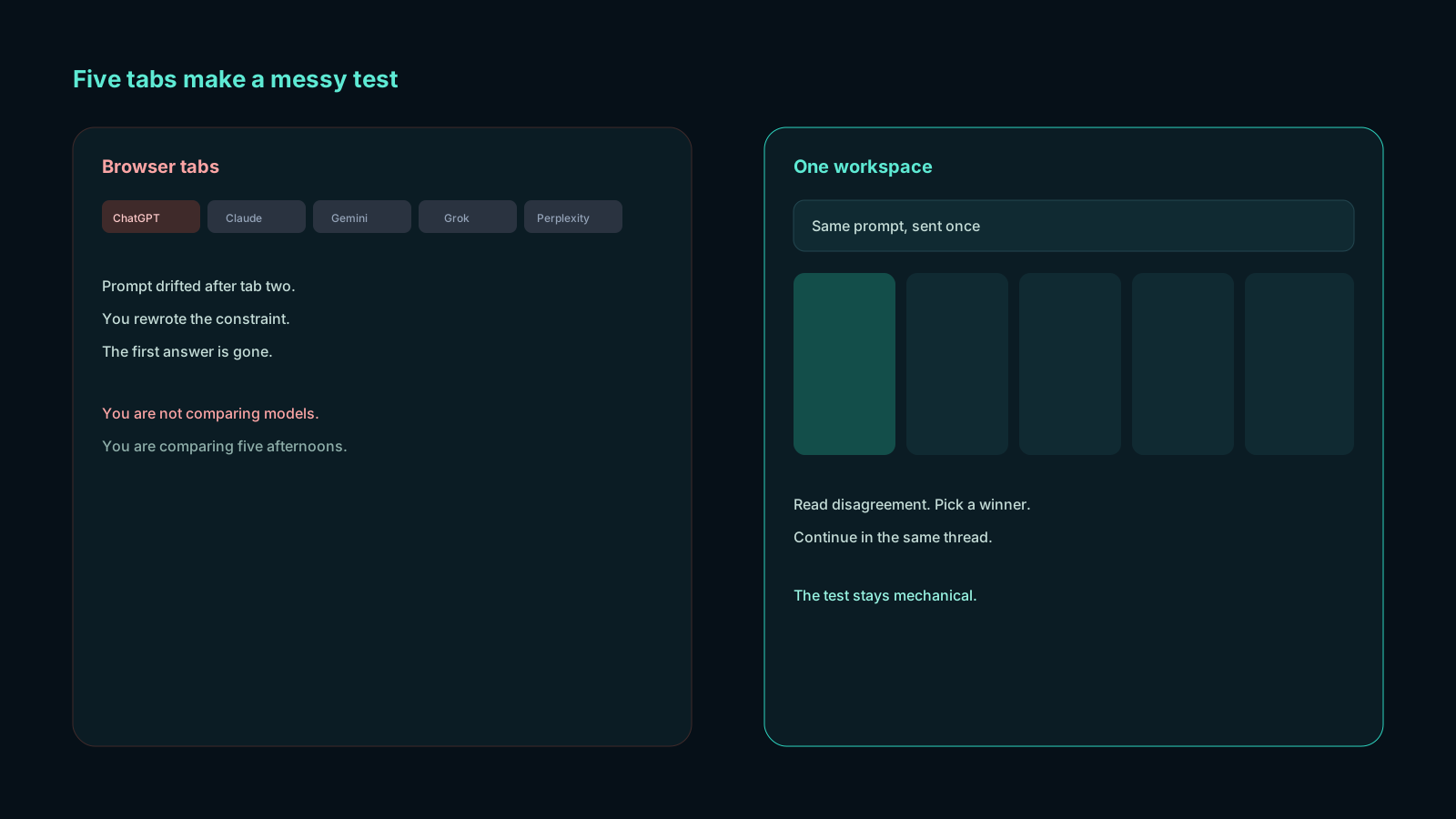
A fair ChatGPT vs Claude vs Gemini test dies in the browser.
You type the prompt in one tab, then you tweak it in the next because you thought of a constraint. Now the prompts are different. You wait, you scroll, you lose the first answer. You copy the “best” paragraph from memory. You cannot say which model wrote the line you kept.
Same problem with five subscriptions: five invoices, five histories, five slightly different system defaults. You are not comparing models. You are comparing five products you used on five different afternoons.
The test that works is mechanical: one prompt, five streams, one screen, then a follow-up with the model you choose.
How to run the same prompt across all five models
You can do this in a comparison workspace instead of juggling accounts.
- Open chat. Guest chat works if you only want a single round.
- Write one prompt with the real constraints: audience, length, format, and what to avoid.
- Send it once. ChatGPT, Claude, Perplexity, Gemini, and Grok stream in parallel.
- Read for the job, not for sparkle. Check whether the answer followed instructions, invented numbers, or skipped the hard part.
- Continue the thread with the model you would actually use for the next draft, the next function, or the next citation check.
- Register if you want that thread saved. Guest chat does not keep history.
Compare these models on Chativo with a prompt you already care about—an email, a failing function, a research question. Then See packages if you need this daily.
Starter is $5/month, Plus is $10/month, and Pro is $20/month. Checkout is Pakistan-friendly via Safepay. ChatGPT Plus is typically around $20 a month for one model; stacking Claude, Gemini, Grok, and Perplexity on top of that is a different budget conversation.
There is no best AI model 2026 for every task
A model wins a task, not a year.
Winning looks like:
- You did not have to rewrite the structure.
- The claims are checkable, or clearly marked as opinion.
- The code matches the error you pasted.
- The tone would not get you in trouble with the person who will read it.
Losing looks like:
- A confident date, price, or citation you cannot verify.
- A polite essay that ignored your constraints.
- A patch that imports a library you do not use.
- A research answer with no path back to a source.
ChatGPT vs Claude vs Gemini is useful as a search. It is a poor way to buy a personality for every job. Keep the comparison, drop the crown.
If you write for work, run one prompt this week that already matters. Do not use a toy question. Toy questions produce toy winners.
Frequently asked questions
Straight answers to the questions this article usually raises. Each question is separate from its answer so you can scan on a phone or a desktop.
Is there a clear winner in ChatGPT vs Claude vs Gemini?
No. ChatGPT vs Claude vs Gemini is a three-way split that depends on the task. ChatGPT is the flexible default, Claude often wins careful writing and review, and Gemini is a reasonable pick for clean explainers. Add Grok for blunt speed and Perplexity when you need the live web.
Which model is best for research in 2026?
Perplexity is the research-first choice because it is built around finding and citing public pages. ChatGPT and Claude are stronger once you already have notes and need a structured argument. Use both moves: gather, then write.
Can I compare ChatGPT vs Claude vs Gemini vs Grok without five subscriptions?
Yes. A multi-model workspace sends one prompt to ChatGPT, Claude, Perplexity, Gemini, and Grok together. You read the answers in one view and continue with the model you trust, instead of paying five separate bills to run one test.
Do I need an account to try a five-model comparison?
No. Guest chat lets you run a prompt. Register when you want history, so the comparison you already did is still there tomorrow.
How should I pick a plan if I compare models every day?
If the workflow is daily, look at Starter at $5/month, Plus at $10/month, or Pro at $20/month rather than stacking single-model subscriptions. See packages for the current options, including Safepay checkout.
Related reading
- Grok vs Claude: Which AI Is Better for Fast, Direct Answers?
Grok vs Claude is a style contest more than a single winner. Grok is usually blunter and faster to a point; Claude is usually more careful and structured. Compare both on the same prompt, then continue with the answer you would actually send.
- Claude vs Perplexity: Deep Reasoning vs Live Web Answers
Claude vs Perplexity is careful reasoning over your documents versus live, sourced web answers. Use Claude to think, Perplexity to look up, and check every citation.
- Gemini vs Grok: Google AI vs xAI Compared
Gemini vs Grok is Google's productive, ecosystem-minded assistant versus xAI's more informal, direct voice. Neither is a universal winner; test the same prompt on both.