What Is a Multi-LLM Chat Platform and Why Teams Are Switching
9/11/2026 · Chativo Editorial · 7 min read
A multi-LLM chat platform is a chat workspace that can run more than one large language model on the work you are already doing. Instead of living inside a single chatbot, you send a prompt, see how several models respond, and continue with the reply you trust. That is the product type. It is not a model. It is not an API router. It is not a folder of bookmarks.
People search this term after they notice a practical problem: ChatGPT is excellent until it is not, Claude is careful until you need a different cut, Perplexity is current until you need a narrative, Gemini and Grok each change the answer again. Switching tabs is a workaround. A multi LLM workspace is the designed version of that workaround.
This article does not invent a migration wave or a percentage of teams “switching.” It explains the job, the reasons people add a second and third model, and what to demand from an LLM comparison platform before you put real work in it.
What a multi-LLM chat platform actually is

A multi-LLM chat platform has four parts that belong together.
Several models in one account. The interesting set for daily work is not “every model on earth.” It is a small group with different habits. ChatGPT, Claude, Perplexity, Gemini, and Grok cover general drafting, careful prose, live research, Google-adjacent work, and a more direct conversational style.
One prompt, parallel answers. If you must remember to open a second bot, you will skip it when you are busy. The platform should request the answers together and stream them so you can start reading before the slowest model finishes.
A continue-with-winner step. Comparison without a next action is a demo. After you choose, follow-ups should stay with that model so the thread does not fork into five half-conversations.
A place to keep the work. Guest chat is enough to test the idea. History, and then projects, are what make it a workspace instead of a novelty.
Chativo, from MB Stack Company, is built on that shape: compare five replies, select a model, keep the thread. You can compare these models on Chativo without an account. See packages for Starter at $5, Plus at $10, and Pro at $20 when you want a paid plan.
If you want a buying guide rather than a definition, continue with the best multi-model AI chat platform article. If you want the same idea from the comparison-tool angle, see best AI chatbot comparison tool.
What it is not

Category language gets sloppy. A multi-LLM chat platform is not:
- A single-vendor chatbot with a model picker. Switching from one GPT-class model to another inside the same product is useful. It is still one house style.
- A developer gateway. An API router lets software call many models. That is infrastructure. You still have to build the chat, the compare view, and the continue-with-winner control.
- A bot directory. A long list of personalities is entertainment and experimentation. A comparison platform is organized around one assignment and several independent drafts.
- An automated ensemble that votes. Some research systems mix models in the background. A chat platform for people still expects a human to read and choose.
If a product cannot show you disagreement on the same prompt, it is not doing the job this article describes.
Why people run several models in the first place
Teams and serious solo users add models for reasons you can watch in a single afternoon. None of these require a statistic.
Different errors. Models do not hallucinate the same missing fact, and they do not dodge the same constraint. A second draft is a cheap review.
Different strengths. You might want Perplexity’s source-seeking habit on a live question, then Claude’s tone on the email that reports the finding. That is one task, two jobs.
Different audiences. The version you send to engineering is not the version you send to a client. Running the same brief through more than one model is faster than rewriting from a blank page.
Continuity insurance. Products change. Rate limits hit. A feature moves behind a plan. If your whole practice lives in one chatbot, a bad week is an outage. A multi LLM workspace keeps the work portable across ChatGPT, Claude, Gemini, Grok, and Perplexity.
Shared language for review. When two people argue about “what the AI said,” they are often arguing about two different prompts. Putting the prompt in one place, with several replies attached, makes the review about the assignment.
Those are practical reasons people stop living in a single LLM. A platform just makes the behavior less fragile.
What an LLM comparison platform should include
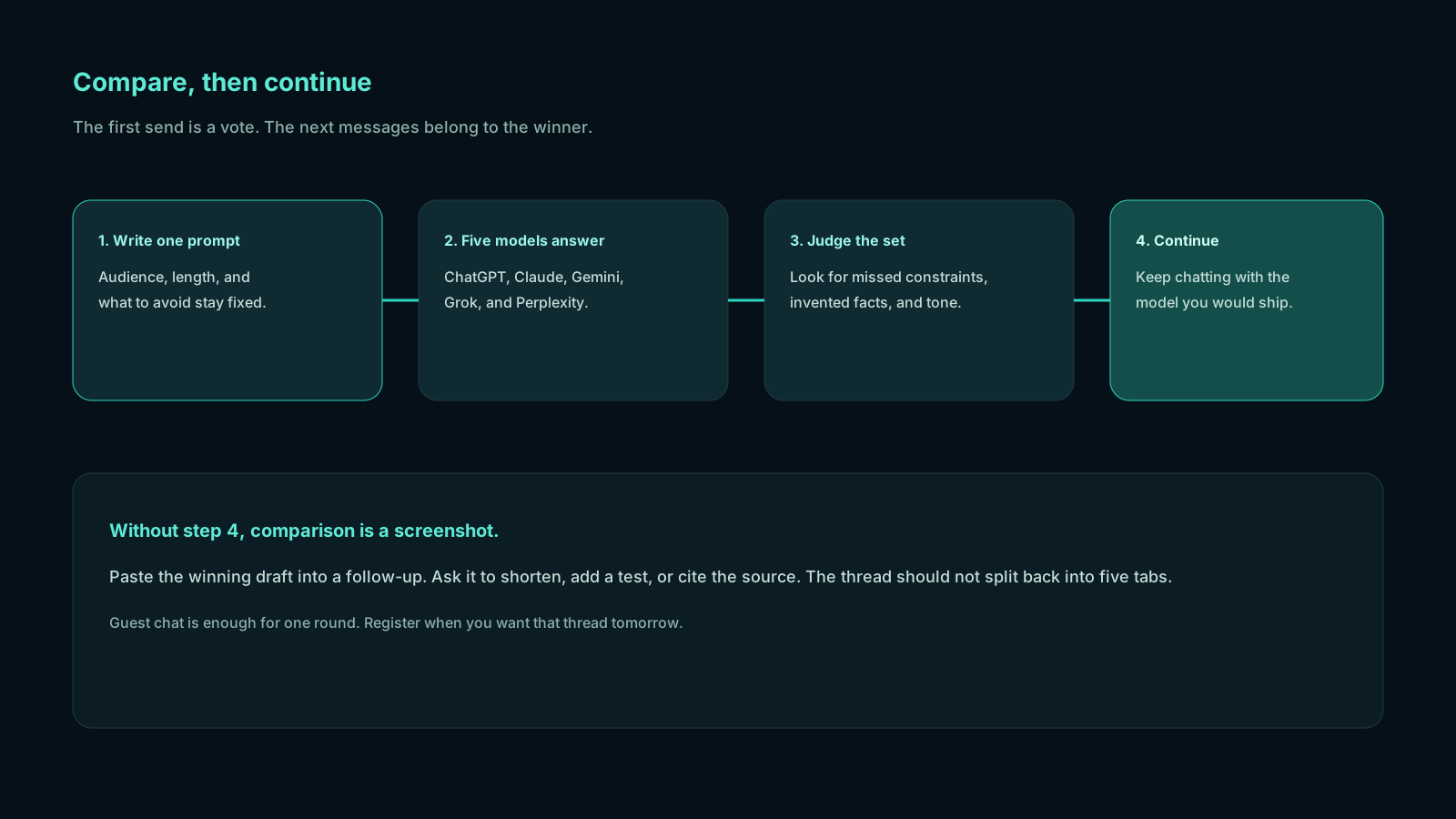
Use this as a checklist when you evaluate any multi-LLM chat platform.
| Capability | Why it matters |
|---|---|
| Parallel streaming | You read while answers arrive instead of waiting in sequence |
| Shared prompt | Comparison is invalid if each model got a different brief |
| Continue with winner | Follow-ups need a single spine |
| Guest try | You should test on a real prompt before you pay |
| History after register | Daily work is a series, not a screenshot |
| Projects | Client, repo, or course work needs grouping |
| Clear plans | You should know what $5, $10, and $20 buy |
Chativo’s public plans are Starter $5, Plus $10, and Pro $20. Guest chat exists. Projects require a signed-in account. Light and dark themes are there because people actually sit in this UI for an hour.
The models in the first send should be named. “Many AIs” is marketing. ChatGPT, Claude, Perplexity, Gemini, and Grok in one app is a concrete promise. That lineup is covered in ChatGPT, Claude, Gemini, Grok, and Perplexity in one app.
How a working day looks on this product type
Morning: you paste a messy brief. Five drafts appear. You keep Claude’s caution and ChatGPT’s outline, then continue with one model to produce the sendable version.
Midday: a teammate drops a research question. Perplexity leads. You still read the others so you do not ship a thin summary. You continue with the research-shaped winner until the claims are tight, then you write the memo on a prose-shaped model if you need to.
Afternoon: a coding question. Two implementations disagree. That disagreement is the review. You continue with the plan that matches your repo, then you run it in a real environment. The platform did not replace your compiler. It replaced the five-tab ritual.
None of this requires a slogan about teams switching. It requires a workspace that treats comparison as the default, not as extra credit.
How to adopt one without disrupting the team
If you work with other people, do not start with a mandate. Start with a shared prompt.
- Take a recurring artifact: weekly update, support macro, proposal opener, incident summary.
- Run it through several models on the same text.
- Agree, in writing, what “winner” means for that artifact: accuracy, tone, length, or risk.
- Continue only the winning thread so comments stay in one place.
- Save the thread in a project once the format stabilizes.
The multi-LLM chat platform is doing its job when the argument moves from “which chatbot do we like?” to “which reply matches the assignment?” That is a better conversation for a team, a consultancy, or a class.
You can rehearse the same loop alone in guest chat, then register when the threads are worth keeping.
Compare these models on Chativo. See packages when you are ready for a plan.
If you are evaluating vendors, ask them to run your prompt, not theirs. A multi-LLM chat platform that only looks impressive on canned demos will hide the disagreements that matter in your work.
Frequently asked questions
Straight answers to the questions this article usually raises. Each question is separate from its answer so you can scan on a phone or a desktop.
What is a multi-LLM chat platform in one sentence?
It is a chat workspace that runs several large language models on one prompt, shows the answers together, and lets you continue with the model you choose.
How is a multi LLM workspace different from opening five chatbots?
Five chatbots means five logins, five pastes, and five histories. A multi LLM workspace keeps the prompt identical, streams in parallel, and gives you a winner to continue with. The logistics are the product.
Do teams need this, or is it for individuals?
Both. Individuals use it to review their own drafts. Groups use it so “what the model said” refers to one prompt and several replies, not to whoever opened ChatGPT first. This article does not claim a measured migration rate; the reasons are operational.
Is an LLM comparison platform the same as an API router?
No. A router is for software. A comparison platform is for people reading answers. You can use both. You should not confuse them.
Can I try a platform before I subscribe?
Look for guest chat. Chativo lets you start without an account, register for history, and choose Starter $5, Plus $10, or Pro $20. Projects are for signed-in users.
Related reading
- ChatGPT, Claude, Gemini, Grok, and Perplexity in One App
Run one prompt across ChatGPT, Claude, Gemini, Grok, and Perplexity in a single chat, then continue with the answer you actually want to use.
- Best Side-by-Side AI Comparison App for Daily Work
A side by side AI comparison app should stream several model replies on one prompt, then let you continue with the winner. Here is what daily work actually needs: parallel chat, projects, and guest mode.
- Best Multi-Model AI Chat Platform in 2026
The best multi-model AI chat setup is comparison-first: one prompt, five live answers from ChatGPT, Claude, Gemini, Grok, and Perplexity, then a follow-up with the model you choose.