How to Get Better AI Answers by Comparing Multiple Models
9/11/2026 · Chativo Editorial · 7 min read
The fastest way to compare multiple AI models is to ask once and read the answers together. ChatGPT, Claude, Perplexity, Gemini, and Grok will not fail in the same way, and they will not shine in the same way. If you treat the first fluent reply as finished work, you are using a draft as a decision. If you treat five replies as a short review meeting, you get the best of several AI answers without turning your afternoon into a tab farm.
This is sometimes called ensemble AI chat: not because the models vote in a formal system, but because you, the reader, pick a winner. The habit is simple enough to teach in a page. The payoff is better writing, safer claims, and fewer “why did I send that?” moments.
Why you should compare multiple AI models on the same prompt

A single model optimizes for a plausible next paragraph. That is useful. It is also how confident mistakes get into emails, briefs, and code. When you compare multiple AI models, you are not hunting for a mystical average. You are looking for disagreement.
Disagreement is information:
- One answer cites a mechanism; another skips it.
- One answer is kinder to the reader; another is clearer to a lawyer.
- One answer invents a statistic; another admits it does not have the number.
- One coding plan mutates state in place; another is easier to test.
You cannot see those gaps if you only open the assistant you like. You also cannot see them if you change the prompt each time. The prompt has to be identical. That is the whole difference between “I tried a few tools this month” and “I ran an ensemble on this task.”
Chativo is built for that ensemble AI chat loop. One prompt streams across five models. You continue with the winner. Compare these models on Chativo on a task you already have open. See packages when you want Starter ($5), Plus ($10), or Pro ($20) instead of a one-off guest session.
Ask once, pick the winner
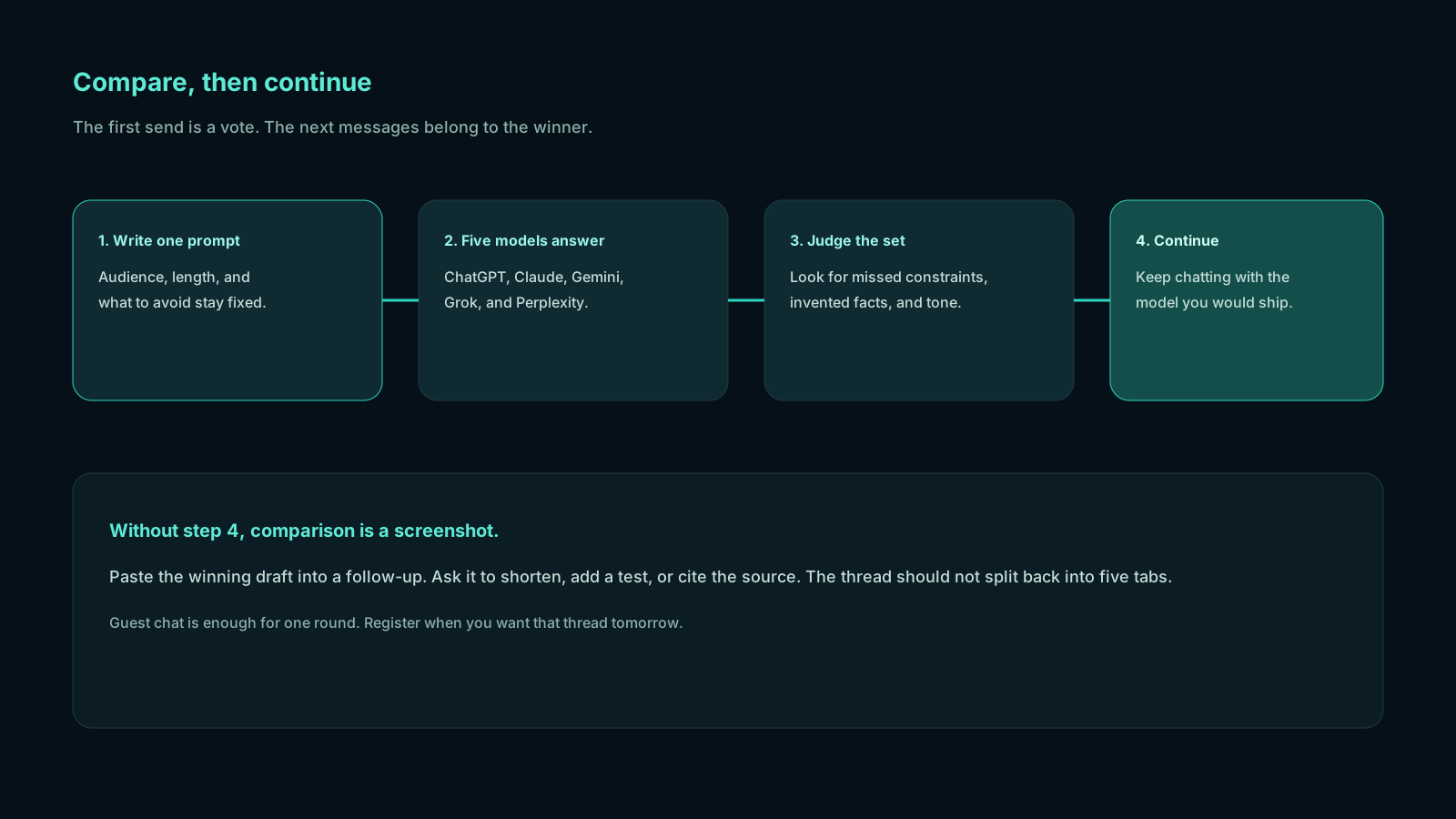
Here is the workflow. It should feel boring. Boring is the point.
1. Write the real prompt. Include the audience, the format, the length, and what you refuse to invent. “About two hundred words, no fake metrics, end with two options” is a prompt. “Make this better” is not.
2. Send it to several models at the same time. ChatGPT, Claude, Perplexity, Gemini, and Grok is a practical set for writing, coding, and research. You are not collecting logos. You are collecting independent drafts.
3. Read for a job, not for a vibe. Score each reply against the assignment. Ignore which brand you subscribed to last year.
4. Name a winner for this thread. The winner is the answer you would actually use, or the answer whose skeleton you will keep. You can steal a sentence from second place. You should not keep five parallel conversations alive.
5. Continue with that model. Follow-ups, constraints, and “now make it shorter” belong on the winning thread so the conversation stays consistent.
That is how you compare multiple AI models without turning every task into a research paper. Ask once. Pick the winner. Move.
If you want the mechanics of layout rather than the review habit, use the step-by-step in how to compare AI models side by side. If you want the landscape of strengths, keep ChatGPT vs Claude vs Gemini vs Grok vs Perplexity nearby.
What better means on real work

“Better” is not a leaderboard. It depends on the cost of being wrong.
Writing and client communication
Better means the reader feels respected and the facts you provided are intact. When you compare multiple AI models on an email, watch the first sentence and the ask. Many drafts bury the point. One draft will usually be sendable after a human pass.
Research and claims
Better means the model does not fabricate a study, a quote, or a number. Perplexity is often the one that behaves like a researcher. ChatGPT and Claude are often stronger at turning sources into a narrative. Gemini and Grok can still catch a framing you missed. The ensemble is: retrieve, then interpret, then refuse the invented citation.
Comparing answers is one of the practical ways to reduce AI hallucinations. It is not a guarantee. It is a review step you can actually do.
Coding
Better means the approach would survive contact with your repo. Look for hidden assumptions, missing tests, and APIs that sound real. Two models that propose the same algorithm are more interesting than one model that writes more comments. Continue with the winner, then paste into a real environment.
Decisions
Better means options and tradeoffs, not a fake sense of certainty. If every model picks the same vendor after you withheld the constraints, you under-specified the prompt. If they split, you have a meeting agenda instead of an oracle.
How to read five answers without drowning
You do not need a spreadsheet. You need a pass order.
Pass one: disqualify. Drop any answer that invents facts, ignores a hard constraint, or changes the assignment. This is where ensemble AI chat earns its keep. The best of several AI answers is sometimes “none of these, rewrite the prompt.” More often, one draft is immediately unusable and you stop wasting time on it.
Pass two: structure. Which reply has the outline you would keep? Headings, sequence, and the ask at the end matter more than a pretty adjective.
Pass three: risk. Which reply is safest to send? Caution can be wisdom or waffle. You decide.
Pass four: voice. Which reply sounds like something you would sign? If none do, take the structure from the winner and rewrite the opening yourself.
Then stop. The point of compare multiple AI models is not to merge five essays into a chimera. Over-merging creates bland, contradictory copy. Pick a spine. Borrow a line. Continue.
Mistakes that make comparison useless
Changing the prompt between models. You are no longer comparing systems. You are comparing assignments.
Asking for “the best” in the prompt. Models will perform confidence. Ask for the artifact you need.
Keeping every thread warm. Context splits. Your follow-ups diverge. The ensemble collapses into five chats you will not reread.
Treating speed as quality. A fast reply can still be wrong. Streaming is for reading, not for scoring.
Looking for a permanent winner. ChatGPT can win the outline and lose the tone. Claude can win the caution and lose the punch. Perplexity can win the sources and lose the narrative. The winner is per task.
Skipping a human check on numbers and names. Comparison reduces certain errors. It does not replace you.
Make the habit cheap enough to keep
People abandon good methods that take twelve minutes of logistics. Opening five websites, pasting, waiting, and copying back is why most of us do not compare multiple AI models even when we know we should.
A dedicated workspace removes the logistics:
- One composer
- Parallel streams
- A continue-with-winner control
- History after you register
- Projects when the work is a series, not a one-off
That is Chativo’s product shape, from MB Stack Company. Guest chat lets you run the method on a live prompt. You register when you want the thread to persist. Plans are Starter at $5, Plus at $10, and Pro at $20.
Compare these models on Chativo. See packages if the habit should live on a plan instead of in five bookmarks.
Use the method on tomorrow’s first real task. Not a toy. A paragraph you would otherwise send after one pass. Ask once. Read the disagreement. Continue with the winner. That is how you get better AI answers without pretending any single model is a staff.
Frequently asked questions
Straight answers to the questions this article usually raises. Each question is separate from its answer so you can scan on a phone or a desktop.
Is comparing multiple models the same as ensemble AI chat?
In this article, yes: ensemble AI chat means several models answer one prompt and a human picks the best of several AI answers. It is not an automated voting layer. You still decide.
How many models do I need?
Two is already better than one for high-stakes work. Five is useful when the models are different on purpose: a generalist, a careful writer, a research tool, a Google-family model, and a direct conversational model. More than that is usually noise unless you have a specialist need.
Will this slow me down?
The first compare takes longer than trusting one chatbot. The send-and-regret loop takes longer than both. Once the workspace asks once for you, comparison is often faster than tab-switching.
Can I mix sentences from every model?
Sparingly. Borrow a heading or a closer. If you splice five voices, you get mush and hidden contradictions. Continue with one winner so the next edits have a single spine.
Can I try this without buying five subscriptions?
Yes. Send one prompt across ChatGPT, Claude, Perplexity, Gemini, and Grok in a comparison workspace. Chativo guest chat is built for that. Register for history; use Starter, Plus, or Pro when you want a paid allowance.
Related reading
- How to Reduce AI Hallucinations by Comparing Model Answers
Cross-check ChatGPT, Claude, Perplexity, Gemini, and Grok on the same prompt so invented facts show up before you trust a single reply.
- How to Choose the Right AI Model for Any Task
Match the task to the model, then verify with a live compare. This AI model selection guide shows which AI model you should use for writing, coding, research, and fast answers.
- Stop Switching Between ChatGPT and Claude: Use Both in One Chat
Use ChatGPT and Claude together on the same prompt instead of bouncing between tabs. Compare both with Gemini, Grok, and Perplexity, then continue with the winner.