Best AI Writing Assistant in 2026: ChatGPT, Claude, Gemini, or All Three?
9/6/2026 · Chativo Editorial · 9 min read
The best AI writing assistant in 2026 is the one that already sounds like you before you start editing. ChatGPT is often the most flexible first draft. Claude is often the best editor of a long brief. Gemini is often the cleanest at structure and extraction. Grok is often the most spoken and direct. Perplexity is useful when the piece needs a live fact, not a remembered one. Guessing which model to open is how drafts go generic. Comparing the drafts is how you keep a voice.
Writers do not need a mascot. They need a paragraph they would publish.
Compare these models on Chativo
| Job | ChatGPT | Claude | Gemini | Grok |
|---|---|---|---|---|
| Voice | Adaptable; can sound generic if the brief is thin | Steady, careful, good at matching a pasted sample | Clear and even; less personality unless you demand it | Informal and punchy; can be too casual for formal work |
| Editing | Strong at “make this shorter / clearer” | Strong at preserving meaning while cutting | Strong at headings, tables, and reordering | Strong at removing stiffness; weaker at legal-adjacent tone |
| Long-form | Good outlines and mid-length pieces | Best at holding constraints across a long draft | Good at section maps and summaries | Better as a pass after a longer draft exists |
| First draft speed | Fast to a complete shape | Fast to a complete, cautious shape | Fast to a structured shape | Fast to a spoken shape |
| Failure mode | Smooth filler, stock transitions | Extra caveats, extra length | Flat tone, template headings | Joke or swagger where you needed calm |
Perplexity is the fifth card: use it when a sentence depends on a current page, then continue with the writing model that already has your voice.
What the best AI writing assistant should do

A writing tool is not “good at English.” That bar is gone. The remaining bar is whether it can do three jobs without flattening you.
Voice. The assistant should copy a sample, not a brand of AI. If you paste two paragraphs of your own work and say “match this,” the winner is the model whose next paragraph could pass as a continuation. ChatGPT will try. Claude will try more literally. Gemini will often produce a cleaner but colder cousin. Grok will often produce a looser cousin. All three of ChatGPT, Claude, and Gemini can fail this if your sample is too short. Give them 150–300 words of you, plus the audience, plus words you refuse.
Editing. The assistant should cut, not decorate. “Make this better” is how you get adjectives. “Cut 30% without losing the decision in paragraph two” is how you get an editor. Claude is usually the safest pair of hands on a draft you already like. ChatGPT is usually the fastest at a requested format change. Gemini is usually the best at turning a wall of text into sections. Grok is usually the best at killing corporate padding.
Long-form. The assistant should remember the brief on page two. That is where people over-trust a single chat. Models drift. They reintroduce a claim you deleted. They change the product name. The practical defense is a tight brief at the top of every long prompt, plus a compare step at the outline stage, not only at the final polish.
If you want a best AI for writing that is honest, it is a workflow: outline from several models, pick the spine, continue with the model that already sounds like the piece, then run a second compare only when you change audience or length.
For the two-model classic, see ChatGPT vs Claude. For Gemini’s contrast with OpenAI, see ChatGPT vs Gemini. Creators who also script and caption should read best AI for content creators.
Best AI for writing: voice, editing, and long-form
Stop asking which company “wins writing.” Ask which job you are in.
Voice
Paste a sample. State the audience. Ban the phrases you hate. Then send the same brief to every model.
ChatGPT often lands a usable default: readable, slightly polished, slightly interchangeable. That is fine for a first email. It is death for a newsletter with a personality. Claude often keeps more of your sample’s cadence, including your odd punctuation if you have it. Gemini often “corrects” you into a heading structure. Grok often makes you sound like you talk. If your brand is calm and precise, Grok may be a second pass, not the first.
The compare view is the only fair AI writing tool comparison for voice. You cannot remember how ChatGPT sounded last week. You can read five opening paragraphs in one sitting and keep the one that does not sound like a template.
Editing
Never start an edit by pasting the draft into a new model with “improve this.” You will get a different article. Start with instructions:
- Keep the thesis in sentence one
- Cut repetition
- Do not add examples I did not supply
- Do not add statistics
- Return a diff-style list of what you changed
Claude is usually best at obeying that list. ChatGPT is usually best if you also want a second version in a new format (bullets, landing-page copy, FAQ). Gemini is usually best if the problem is order, not sentences. Grok is usually best if the draft sounds like a committee.
If two editors disagree, that is useful. One is protecting your meaning. One is protecting your speed. Continue with the one whose cut you would defend to the author—which, in this case, is you.
Long-form
Long-form is where a single-model chat lies to you. The first 400 words look like your brief. The next 400 quietly change the promise. Compare at three checkpoints:
- Outline only. Five models, one prompt, no prose yet.
- Opening section. Continue with the winner, then compare a second opening if it feels generic.
- Final cut. Paste the full draft back and ask each model (or at least two) to list contradictions, repeated claims, and missing promised sections.
Claude usually wins checkpoint 3. ChatGPT or Gemini often win checkpoint 1. Grok is a good checkpoint-2 editor if the opening is stiff. Perplexity should not write your essay. It should challenge a dated claim before you publish.
This is why “ChatGPT, Claude, Gemini, or all three?” is the right title. All three, plus Grok and Perplexity when the piece needs them. The best AI writing assistant is the one you continue with after you have seen the set.
AI writing tool comparison by draft type

Match the draft to the failure you cannot afford.
Email and short replies. Grok or ChatGPT for speed. Claude if the email can be forwarded to a client. Gemini if you need a version with a clear ask and a subject line.
Landing page. Compare everyone. Voice is the product. Continue with the model whose headline you would actually run, then ask it for the rest of the page in the same register.
Newsletter. Paste two past issues. Claude and ChatGPT are the usual finalists. If both sound like LinkedIn, your sample was too short or too generic.
Documentation. Gemini and Claude. Demand the same headings as the existing docs. Ban marketing words.
Thought leadership. Your outline must come from you. Use models to pressure-test the argument: “What would a skeptical reader reject in section two?” That is an edit, not a ghostwrite.
Research-backed posts. Outline with Claude or ChatGPT. Check live claims with Perplexity. Do not let any model invent a statistic. If a number did not come from a source you opened, delete it.
An AI writing tool comparison that only lists “creativity” and “accuracy” is not usable. Your table should be the one above, applied to the piece on your desk.
How to compare drafts instead of guessing
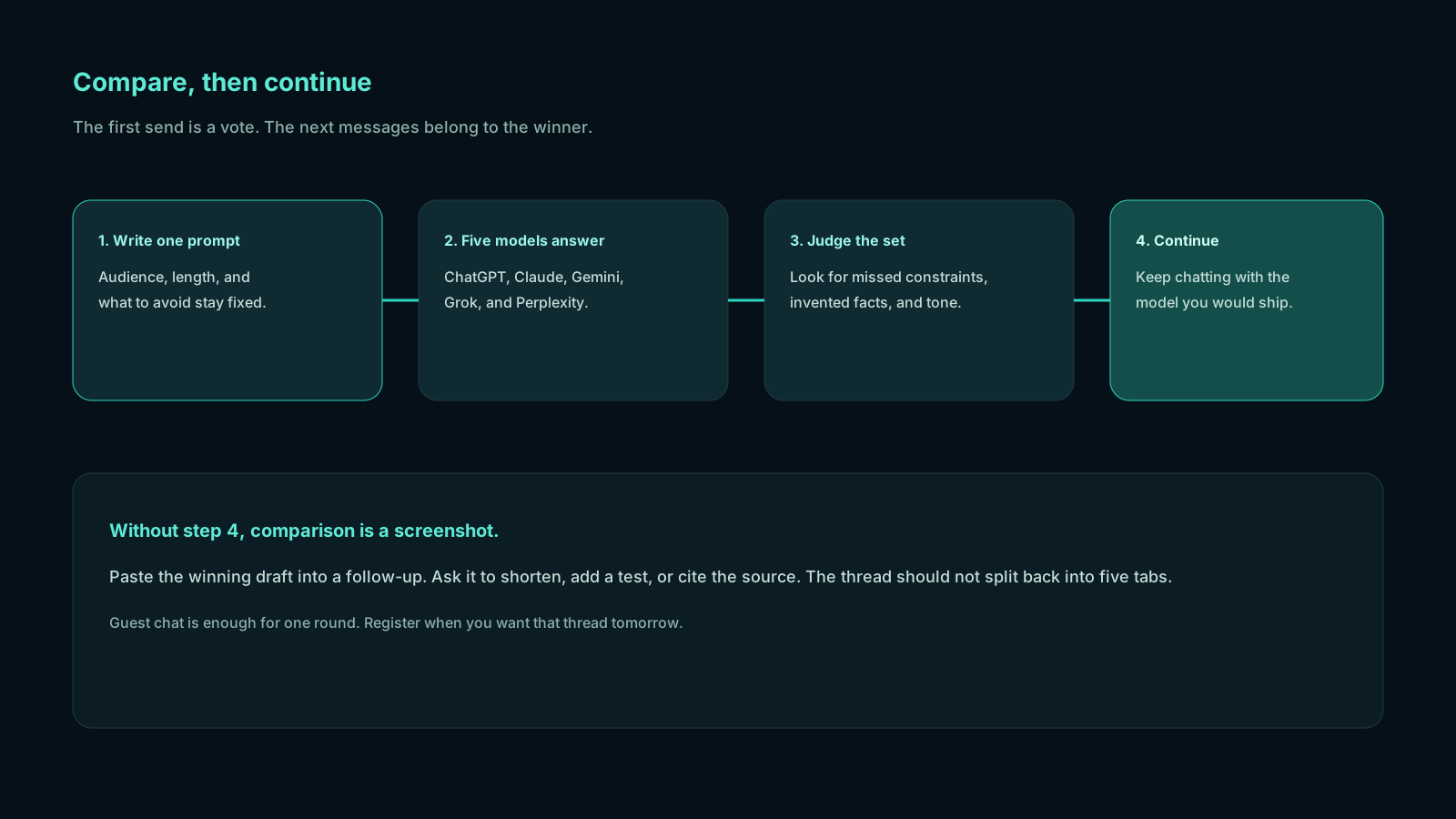
Open a compare chat. Paste one brief. Include audience, length, banned phrases, and a voice sample. Read ChatGPT, Claude, Perplexity, Gemini, and Grok together. Continue with the winner so the next 20 turns stay in that voice. That compare-then-continue loop is how a best AI writing assistant actually earns the title: not by being your only tab, but by winning the draft in front of you.
A brief that works:
Audience: staff engineers who already hate AI hype.
Length: 180–220 words.
Voice: match the sample below. Short sentences. No metaphors I did not write.
Task: explain why we compare model drafts before we publish docs.
Do not add statistics. Do not mention awards. End on a next step.
Sample: [paste 150–300 words of your writing]
Guest chat is enough to run this once. Register to keep the thread. MB Stack Company prices the workspace at Starter $5/month, Plus $10/month, and Pro $20/month, with Safepay checkout in Pakistan.
Compare these models on Chativo · See packages
Frequently asked questions
Straight answers to the questions this article usually raises. Each question is separate from its answer so you can scan on a phone or a desktop.
What is the best AI writing assistant if I write every day?
The best AI writing assistant for daily work is the one whose first draft already matches a sample of your writing, after you have seen the others. Many people default to ChatGPT because it is familiar, then spend the session removing generic glue. Compare once, continue with the winner, and only re-compare when the audience or format changes. That is faster than switching tabs and pasting the brief three times.
Is Claude the best AI for writing long-form?
Often for holding a brief, not always for a readable opening. Claude is usually the model that remembers your constraints on page two. ChatGPT or Grok may still win the first screen of a newsletter. The honest method is to compare outlines, continue with the spine you like, and use Claude as the late editor if drift appears. Best AI for writing long-form is a sequence, not a trophy.
How should an AI writing tool comparison handle facts?
Separate drafting from checking. ChatGPT, Claude, and Gemini will write a confident sentence about a product, a date, or a law. Perplexity is the model in the five-way run that is built to retrieve live pages. Still open the page. If you cannot source the sentence, cut it. An AI writing tool comparison that ignores this will reward the most fluent hallucination.
Should I use all three of ChatGPT, Claude, and Gemini every time?
Use all three when the piece is public, priced, or on-brand. Use one continued thread when you are already inside a draft and only need a cut. All three—plus Grok for tone and Perplexity for a live check—is the expensive-piece workflow. A grocery list of edits does not need a committee. A homepage does.
Can I try this as a guest?
Related reading
- Best AI for Emails and Proposals: Compare Drafts from 5 Models
Ask one brief, compare five tones from ChatGPT, Claude, Perplexity, Gemini, and Grok, then continue with the draft you would actually send.
- Best AI Chat for Freelancers: One Prompt, Five Expert Replies
Send one brief. Compare ChatGPT, Claude, Perplexity, Gemini, and Grok on proposals, emails, and pricing copy. Continue with the winner.
- How Developers Compare AI Coding Assistants in 2026
Paste the same bug once. Compare ChatGPT, Claude, Perplexity, Gemini, and Grok. Continue with the model that understood your stack.